


Rev Hendrik du Plessis
Here is a report on our recent proofreading of the Bible books of Daniel and Ecclesiastes, with specific attention to the challenges of the Naro language and the hope for the Qgõo language to also have a Bible of their own, like Naro.
Challenges of the Naro language during proofreading
The recent proofreading of the Bible books of Daniel and Ecclesiastes confronted us as a team with the unique complexity of the Naro language. Naro differs significantly from African languages, especially the Bantu languages. It does not have classes. Nouns are divided into masculine, feminine, and neutral.
These differences extend to the pronouns, which makes it particularly challenging to translate the Bible. For example:
- “You”: Naro has two words for the singular “you”, a feminine “you” and a masculine “you”. In contrast, Afrikaans only has one singular “you” and the English “you” is actually a plural form.
- “You” (Plural): The language has a complex system for “you”, which distinguishes between:
- “You” for men.
- “You” for women.
- “You” for two men.
- “You” for two women.
- “You” for a man and a woman.
- “You” for men and women together.
- “We”: Similarly, there are different words for “we”, which include:
- “We” for men, which is only used by men.
- “We” for women, which is only used by women.
- “We” for men and women.
- “We” for two men, which is only used by two men.
- “We” for two women, which is only used by two women.
- “We” for two, a man and a woman, which is only used by them.
- “They”: A similar variety also applies to the word “they”, which includes:
- “They” for men.
- “They” for women.
- “They” for men and women.
- “They” for two men.
- “They” for two women.
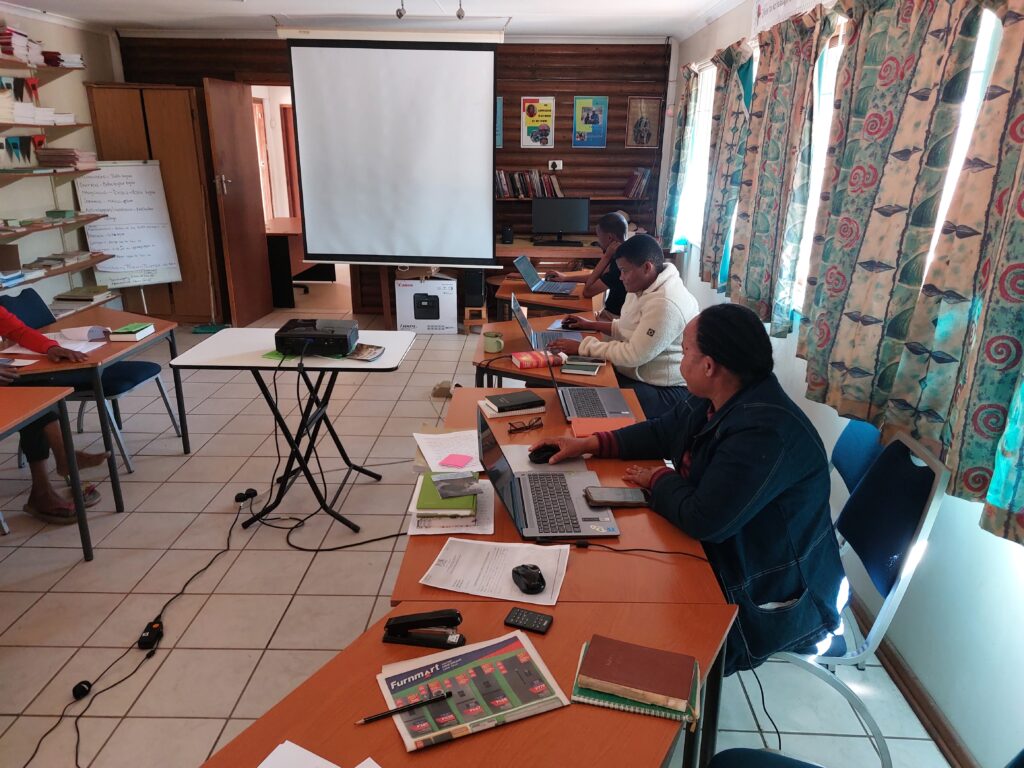
In addition, there is an exclusive form of these pronouns, where you intentionally exclude or include specific individuals. During the translation process, you must therefore constantly be aware of who is involved, so that you can use the correct singular “you”, plural “you”, “them or they”, or “we or us”. When referring to the disciples, you cannot simply say “they or them” as in English. No, you then use the masculine form of “they”. The language is rich and explanatory in this regard. To give an everyday example: Once, I heard people walking past in the dark. I asked them who they were and where they were going. From the answer, I could deduce that there were two women, because the word they used for “we” was the feminine “we” specifically for two women. The proofreading of these passages was long, with us as a team often sitting glued to the table from 8 am until after 5 pm. We worked through verse by verse to ensure the accuracy of the translation, frequently returning to the original Hebrew to find the correct Naro equivalents.
Support and New Hope
During this process, we received support from our consultant, a Mokalaka by birth, from eastern Botswana, who is affiliated with the Bible Society in Botswana. Although she is not a native speaker of Naro, she provided valuable input during our proofreading session. Her husband is Ephraim Baloyi, a Tsonga or Shangaan, and a very good friend of mine during our years together at the University in Potchefstroom. He was later involved with the Bible Society in Cape Town, where he met her. He has recently retired from the Bible Society.
After proofreading Daniel and Ecclesiastes, I informed the consultant about the Qgõo language of Bêre, into which only the Gospel of Luke and a few other isolated passages have been translated. The consultant immediately encouraged me to submit a written proposal, which I did, to emphasize the urgency of the Bible translation for this language and its people. She would then try to facilitate the process. Many people think that the Bushman language is basically one language. No, in Southern Africa, there are approximately 17 Bushman languages and 54 dialects. Languages like Naro and Qgõo are as different from each other as English is from Chinese.
My prayer and request is that the translation process for the Qgõo language will begin as soon as possible, and that the Lord will open doors for this important work.
Communion
We are currently preparing for the Holy Communion next Sunday. The church council is busy with home visits.
For approval
We are pleased to present to the congregation for approval a new candidate for the church council. This individual also serves as the new coordinator of the Naro Bible translation project. As he is still young and innovative, we also have him in mind for ministerial training. If Mukhanyo Theological College offers in-service training, we believe he would be an ideal candidate.
Finally
To conclude, we ask for your intercession for the Qgõo people, that a door may be opened for us to translate the Bible into their language, and also for our new church council member, whom we present to the congregation for approval and the possibility of further training as a minister of the Word. Yours in Christ, Hendrik du Plessis.