

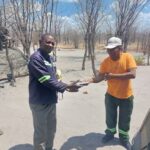


Rev Hendrik du Plessis (November 2025)
Introduction
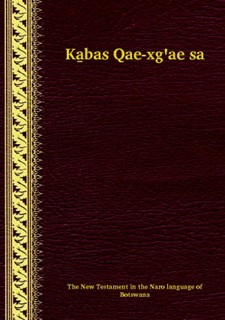
After our return from Mababe on 26 October, we had a week-long revision session. On the left is a photo of the Naro New Testament.
From 27 to 31 October, we had a Bible review session, focusing on the book of Exodus. This session is part of a broader effort to review and translate the Bible into the Naro language. Once the translators have translated a book, we, as stakeholders in the project, are asked to review the book with them again.
Then the book is worked through with them, line by line. The Naro language, spoken by one of the San peoples (Bushmen) in the Gantsi district of Botswana and Namibia, has the New Testament already translated. It therefore requires constant revision to ensure accuracy and cultural relevance. Exodus, as a central book in the Old Testament, presents unique challenges due to its historical, theological, and cultural depth. The session showed that it is a difficult book to handle and translate. There are numerous nuances surrounding the construction of the altar and the colors involved, which are important to be translated.
Challenges in Translation
During the session, we grappled with various translation issues. Exodus contains complex concepts that are not easily translated into many languages, due to linguistic and cultural differences. One of the challenges is to translate keywords that are central to biblical theology. After a long discussion, I proposed a workshop. Such a workshop should then specifically aim to determine the correct translations for critical words through in-depth analysis and collaboration.
Specific words, such as the word “holy,” are an important example discussed during the session. This word has always been difficult to translate correctly in the Naro language, and it is a very important word because it also refers to the “Holy Spirit” in the Bible. This brought us to the question: What does “holy” mean? Over the years, the Naro translators have used different words to convey “holy”, but none of the translations do justice to the real meaning. In a previous Naro translation, the Holy Spirit was even translated as a “Happy or blessed Thought”, which is completely different from the original meaning and the truth. This arose because the Naro language does not have a direct equivalent for “spirit”, and so it was translated as “thought”. Yet they have a word for the Hebrew word “Ruach”, which can mean “wind”, “breath”, or “spirit”. So if you translate “spirit” as a “thought”, what do you do when the word “thought” does appear in the Bible? Just think of the words of the apostle Paul in Romans 11:34, where he says: “For who has known the mind of the Lord. . .” “Mind” or “thought” here is anything but “spirit.”
My explanation of the original meaning to help the translation team led me to explain the original Hebrew meaning. The Hebrew word for “holy” is “qadosh” (or “kadosh”), which primarily means “set apart” or “dedicated for a specific purpose in the service of God.” This does not imply merely moral purity, but rather a state of being set apart for God’s purpose. For example, in the Old Testament, when a priest had to “sanctify” himself, it meant that he dedicated and set himself apart to God for a specific purpose.
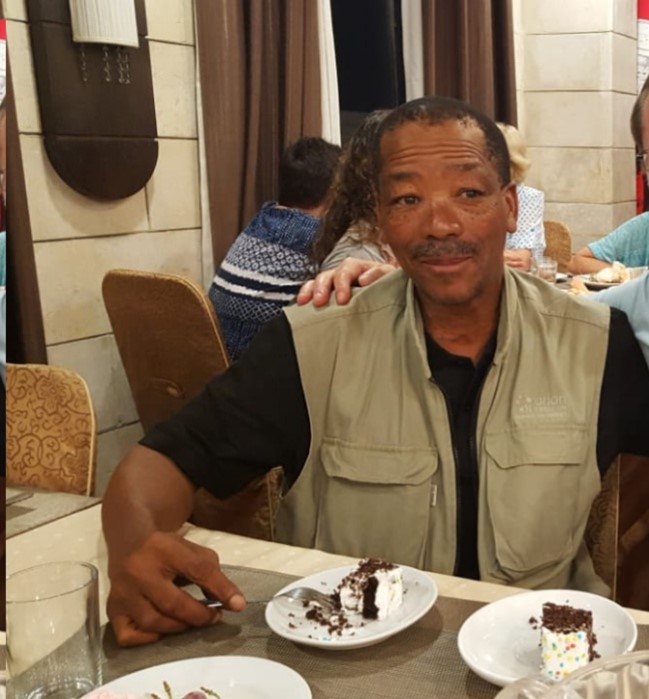
Currently, the Naro translations consistently use “Tcom-tcom sam Tc’ẽe” for the “Holy Spirit,” which is actually the direct translation of the Tswana word “Mowa o o Boitshepo”. The word “Mowa o o Boitshepo” literally means “Trustworthy Spirit”. The Sepedi Bible, in my opinion, is much closer to the truth with “Moya Mokgethwa”, which means “Chosen Spirit”, and is closer to the original Hebrew. The problem with Naro is, they do not have a word for “spirit” and now they translate “spirit” with “a thought”, which makes the word “Trustworthy Thought” for the “Holy Spirit” unbearable, especially if “holy” is translated with “trustworthy”, to become “Trustworthy Thought”. They actually have a word for “spirit” if one considers that “ruach” in Hebrew can also mean breath and wind. When James Morris, a native Naro speaker, interprets the word “spirit” in church, he allways interprets it with the word “c’om,” which means “breath.” The reason the word was not acceptable to the other Naro speakers was because the word for “thought” was already seen as the correct word and the word “c’om” sounded then wrong, and also because the meaning of the Hebrew word “ruach” had never been communicated to them.
In my explanation, I attempted to guide the participants towards a better understanding, emphasizing that it is essential for a translation to remain as faithful as possible to the original language without creating cultural misunderstandings. As has been said, the Naro speaker does have a word for “breath” and “wind” that is not at all foreign to the Hebrew word “ruach,” but the word “thought” can lead to many misunderstandings.
Recommendations and Conclusion
The session highlighted the need for further training and collaboration. The proposed workshop would be a valuable step in addressing these translation challenges by engaging experts to reach consensus on terms such as “holy” and “spirit”. Such initiatives are essential for the continuation of the Naro Bible Translation Project.
This report serves as a summary of the key points from the session, emphasizing the importance of accurate translation for the transmission of biblical truths in indigenous languages.
The funeral of a beloved colleague
Rev. Oster Khoxo was our colleague for many years together with Rev. Gawie Joubert at New Xanagas. According to Google, New Xanagas is 197 km from D’kar. Rev. Oster had not been ill with lung cancer for long. I think he was diagnosed too late.
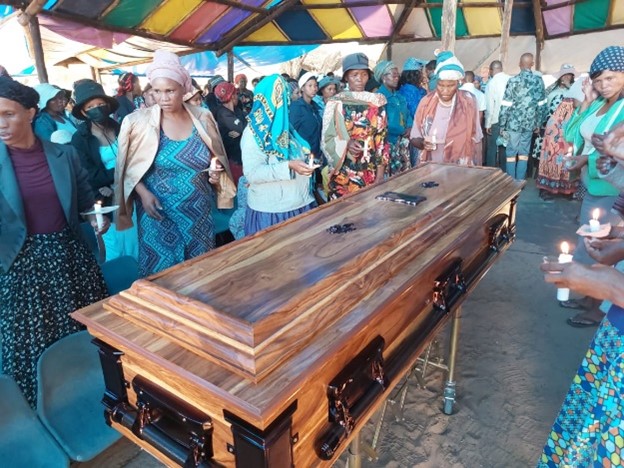
We drove through on Thursday morning to attend the funeral service at 2 o’clock. They asked me to bring a message of comfort. After the service, we met two men from South Africa, Manie and Chris, who came from South Africa to help put up a roof at the church. They brought shade nets (100%) with them. The previous shade net roof was already so battered and full of holes. The next day, they were busy all day pulling the new shade net over the old ones and securing it. The sun was extremely hot. It was Friday. They finished just in time because the body had to be received in the church at around 5 o’clock.
The congregation was already in the church. We, ministers, stood at the gate to await the hearse that was on its way from Gantsi. When the hearse finally arrived, we walked out in front of the coffin to carry it into the church. We had just placed the coffin at the front of the church when a heavy shower of rain fell for about 3 minutes. Some of the few who were still outside got soaked. Suddenly, the rain just stopped. If it hadn’t been for the shade net that was put up in time, we would have all been soaked. Whether it was a miracle, one doesn’t know, because it hadn’t rained before that, and neither had the days after it. Then they took the body to the house where Rev. Oster lived. That evening at 9 o’clock, I had the opportunity to preach the Word again, and the next morning at around 7 o’clock. There were many people that evening and even more the next morning. My colleague from Gantsi, Rev. Seitlheko, handled the funeral arrangements at the grave.
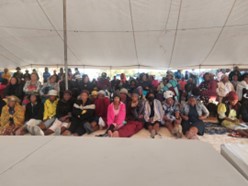
When one is allowed to preach the Gospel of our Lord Jesus, one realizes that it is time to proclaim the Gospel, because there are people who have come from far and wide across Botswana for the opportunity. It is an opportunity that the Lord gives you to preach none other than the risen Jesus Christ, and to testify of his victory over sin and death.
To conclude, we ask for your heartfelt intercession for our Bible translation project, that the Lord will give us the wisdom to translate and interpret His Word correctly. We ask for your intercession for a Bible translation for the Qgõo people who speak a language totally different from our Naro language. It’s like the difference between Afrikaans and Russian. My prayer is that the Lord will, through their language, proclaim the Gospel of our Lord Jesus Christ, according to his command to go and make disciples of all nations.
Your brother in Christ,
Hendrik du Plessis.