


Ministry work from D’kar
This year was not an easy year, it was a year with many challenges, not only in D’kar but also elsewhere on the mission field. D’kar is a congregation that arose in the mid sixties of the last century. There is currently a full-fledged church council and the congregation also reaches out beyond its borders to other ministry points.
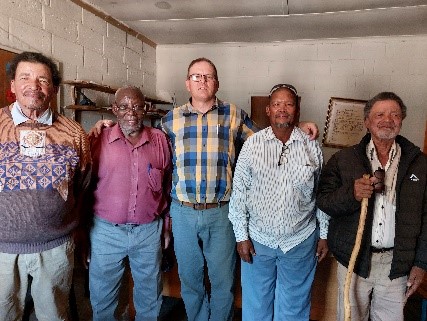
The church council consists of 4 elders, 1 emeritus minister and 1 serving minister. In the photo are from left to right James Morris, Gaobolelwe Ngakayaja, myself, Aron Johanes and Morris Morris. Jim Morris was absent. In total we are 6 on the church council.
What initially was just a mission outreach point now also reaches out to other areas. Of course, it didn’t happen overnight. This happened after years of sustained missionary work. We are currently over 100 professing members and 170 baptized members with 10 in the pre-confession class and four in the confession class. Children in the Sunday school class range from 75 to 200.
Bere
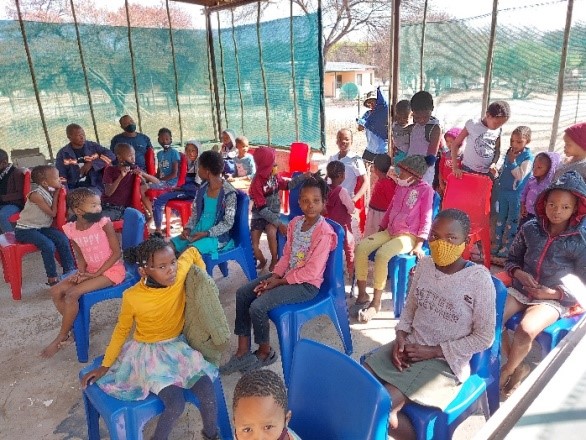
Bere is still a ministry point of D’kar. There is a very competent Sunday school teacher who really has a gift with children. The chairs, clothes and books that we received as donations were a great help to her. We want to once again thank each and every one who contributed to this from the bottom of our hearts, but above all we thank our heavenly Father who made this possible for us.
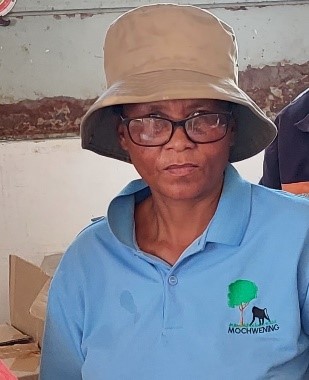
What stands out to me is the fact that she teaches the children core Bible versions. When they get together on a Sunday, the children spontaneously stand up one by one and recite the Bible versions he or she learned that week.
Dr. David Jeremiah once explained it this way: In Ephesians 6, the Word is called the sword of the Spirit. The word used here for “Word” is “Rhema” and not “Logos”. “Logos” is the Word in its entirety, but “Rhema” is a certain scripture from the Word or “Logos” that is given to you by the Spirit like a sword during the battles of the devil and you can defend yourself. You are reminded of certain passages from the “Logos” (Word) called “Rhema” applicable to your circumstances.
Sometimes you when are sad and discouraged the Holy Spirit give you the sword (Rhema), passages from the Bible that you are reminded of and with which you can defend yourself. A Psalm verse or a passage from the Bible come to you at just the right time, and you are comforted.
For the Lord Jesus himself, scriptures were his Rhema or his sword in Matthew 4 when He defended Himself against the attacks of the devil. “It is written” were his words to the devil and then he quotes verses (Rhema or swords), from Deuteronomy.
In John 14:26, the Holy Spirit is referred to as our Comforter: “26But the Helper, the Holy Spirit, whom the Father will send in my name, He will teach you all things, and bring to your remembrance all things that I said to you.” The Holy Spirit comforts you precisely by reminding you. But if you don’t know the Bible, what should He remind you of and what should He comfort you with. When the children of Bere recite the Bible versions off by heart like this, one realizes that these are versions that the Holy Spirit will remind them of and comfort them with later in their lives.
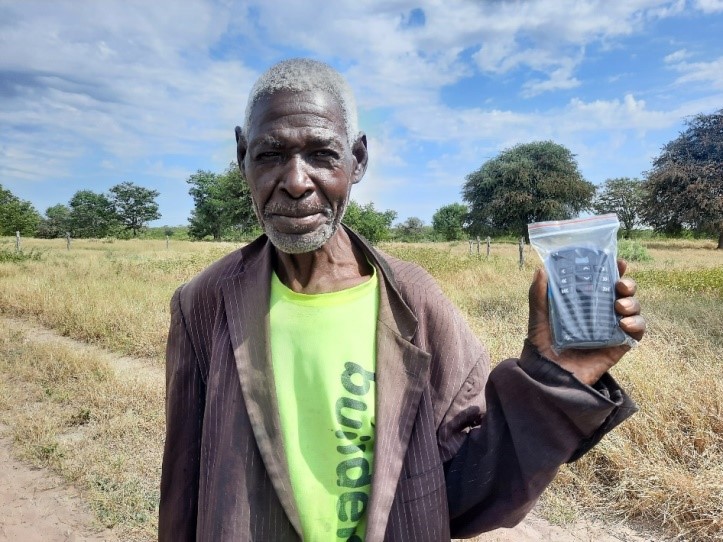
Another big ministry highlight this year was the audio Bibles. Every time you walk by someone’s yard and you hear the Bible being read in the background, you can’t help but think of the words of Paul in Romans 10:17: “So faith comes by hearing, and the hearing is by the word of God.” People who otherwise never came into contact with the Word of God can now listen to it all day long. In John 8:32, the Lord Jesus says to his disciples: “32And you will know the truth and the truth will set you free.”
On the mission field where people have not yet come into contact with the truth of the Word, there is an atmosphere of fear of evil that may befall them. Certain evils can befall you if you do not follow certain rituals dutifully; this strengthens your bond with the traditional doctor, who then in turn shows you through throwing of bones who has bewitched you. Thus leads to friction between families. People hate each other. We have also experienced this several times here in D’kar. Someone’s loved one dies and the family is convinced that a certain person was responsible for this death, that the deceased was bewitched to death. Why? The traditional doctor told them. When he refers to himself as a minister (moruti), everyone is convinced that he is sent by the Lord. This starts a big vicious circle because the traditional doctor becomes the ‘family doctor’ and the ‘minister of faith’ who protects and warns the family against evil, and he certainly does so at a price. The compensation fee is usually cattle and goats.
The only cure for evil doing is the truth of the Gospel that sets you free. We have reached people who hardly ever turn off their audio Bibles. Someone in Mababe told me that he sleeps with his Bible. In the silence of the night, the Bible is read to him and we know that the Word of God never returns empty (Isaiah 55:11).
This year we also realized that people need to be trained even if they cannot read or write. The people are not trained as ministers, but as believers, elders and deacons wherever they live. We can visit them. We can provide them with the material in their own language. We can work through the Bible with them there on the cattle post, settlement or town.
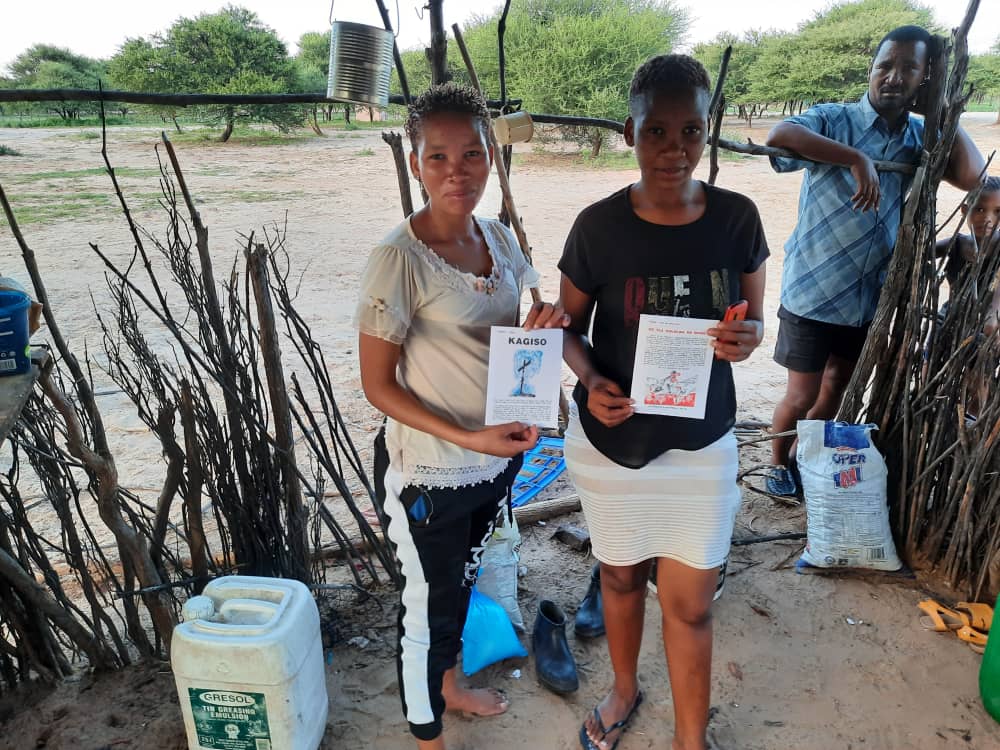
My colleague and I started recording bible studies digitally. The material is then given to a leader figure that can start his own bible study group. Along with the Audio Bible, he also gets a memory stick that they can use. In Botswana, few people have completed their school careers. This means that few qualify for the requirements to enroll at Mukhanyo Bible School. Should we find such a person and he feels called and is willing to be trained, we would not think twice, but unfortunately to become a pastor here in Botswana is a luxury.
It reminds me of South Africa about two centuries ago. The average Afrikaner was illiterate, and there were many congregations that were visited by a minister once in three years. During such a visit, baptism is done, confession of faith is made and the Holy Communion is served. Even though most were illiterate, the people knew the Bible and the congregations flourished. Most of those congregations could never send someone to be trained as a minister, but that did not prevent them from being a congregation. The Bible school starts where you gather people under a tree, and you can visit them from time to time and provide them with learning material. With the audio or sound material, the requirement is no longer that he needs to be literate. If someone can read it is a luxury, but otherwise he or she only has to listen and that they can do well, because they have a listening culture, a memorization culture and not a reading culture. As they listen to the Audio Bible they can also listen repeatedly to the study material. In the end, it’s not just about asking someone if he believes, but if he has the knowledge that supports his belief.
To summarize
The traditional method was to set up a Bible school. People are then sent for Bible training, they are provided with food and accommodation. They are therefore uprooted from their communities to study there. Once they have graduated, they are expected to be able to show the results of their studies.
The modern method is cheaper when you take the Bible school to the student. Beforehand, you make digital sound recordings that you leave with him. It then becomes that person’s responsibility to train people from the outset. He is put to work from day one and it is basically free. All they have to do is listening to the material over and over again. Whether they gather under a tree or in a building, it all depends on them. People who are interested in being trained contact the responsible person and he provides the material provided to him.
The traditional method works, but it costs a lot of money and people are uprooted, while this digital training like Bible study continues indefinitely as they are equipped. Of course they can be given certificates for modules they have completed, but the real test is whether he trains others, because that is now his responsibility. In short, it comes down to this, you help people start their own “Bible Schools” and you also explain it to them that way. It is then nothing else than the biblical principle of making disciples. You train a disciple to train other disciples, and we provide them with the digital material.
To conclude
For us it is a wonderful challenge and I am convinced that if we go to the Lord in our deep dependence, everything will work together for the better in the expansion of his kingdom. We ask that you will pray for us. I often pray the words of the apostle Paul in 2 Thessalonians 3:1 and 2: “Finally, brethren, pray for us, that the word of the Lord may run swiftly and be glorified, just as it is with you, 2and that we will be delivered from unreasonable and wicked men; for not all have faith.” Along with that we read the promise in verse 3: “3But the Lord is faithful; He will establish you and guard you from the evil one.”
Your brother in Christ
Hendrik du Plessis
*(Please note that all photos are posted with the permission of the parties involved)