


Rev Hendrik du Plessis
1. Bible Translation We have completed another intensive review week. This time, our translation team focused on the books of Joshua and 1 Samuel. Once again, the translation options presented a major challenge because the Khoe-San languages are vastly different from other languages. The Khoe-San languages also differ significantly from one another. While the Khoe languages categorize every word as masculine, feminine, or neuter, the San languages are the exact opposite. A simple example: the San languages use the same word for “you” or “your” regardless of gender, just like English or Afrikaans. There is no feminine “you” or masculine “you.” In contrast, the Khoe languages have a distinct masculine and feminine “you/your.” Every word in the dictionary is explicitly categorized as masculine, feminine, or neuter, complete with feminine “you (singular)” and masculine “you (singular),” feminine “our” and masculine “our,” and even specific forms of “we” and “you (plural)” for men and women together, for two men, for two women, for a man and a woman together, and so forth. Consequently, you must constantly verify the exact gender and composition of the people being spoken to or about. Is the Lord Jesus speaking only to His disciples, or were women present as well? If Jesus is speaking only to Mary or Martha, the feminine form must be used whenever “you” or “your” (singular or plural) occurs. We ask for your prayers for this translation work, and also for the upcoming start of the !Xóõ translation (a San language). Naro belongs to the Khoe language family. The Khoe languages differ from each other as much as German differs from English, while the San languages differ from the Khoe languages as much as Chinese differs from English. Fortunately, the San languages largely escaped the grammatical complexity of the Khoe languages.
Our Outreach to Bere Feedback regarding the weekend outreach once again sparked discussions surrounding culture and faith.
- Overview of the Weekend’s Dance Festival
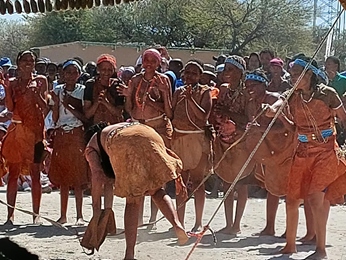
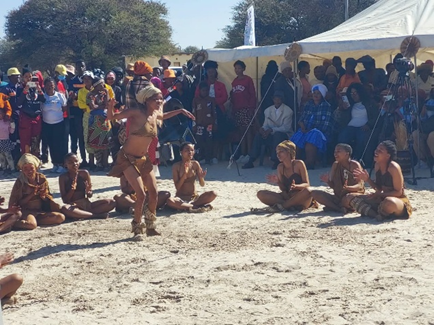
The recent outreach to Bere coincided with the region’s annual dance festival, creating a hive of activity. The event is organized annually by the government as part of its initiative to promote and revitalize local cultures.
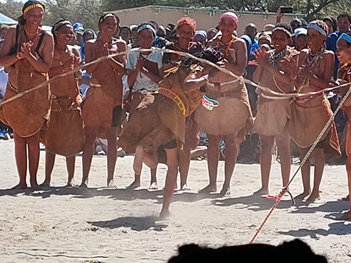
- The festival was attended by high-level officials, ranging from the relevant minister to local government leaders, all of whom delivered speeches during the event.
- Various cultural groups were given a platform to showcase their traditional dances and customs.
2. Spiritual Challenges: The Intertwining of Culture and Cult Following the official proceedings, a personal conversation with our local headman highlighted the community’s deeply rooted spiritual blind spots. There is a total lack of distinction between cultural practices and cultic or occult activities.
- Syncretism (Blending of Faiths): For the headman and many community members, it is considered completely normal and acceptable to confess and serve Christ in church while simultaneously consulting traditional healers.
- Visit from a Traditional Healer: A well-known traditional healer from Tchabo also attended the festival. Some of the rituals involve dancers circling a fire until the healer/shaman enters a trance, after which he lays hands on those seeking healing. The headman himself was very eager to attend this laying on of hands.
- The Headman’s Argument:
- The headman views the shaman’s power as a “God-given gift” that has historically worked for the Bushmen throughout the centuries.
- He believes that traditional practices (such as dancing for rain, health, prosperity, etc.) were always answered by God in the past, and therefore Christianity and traditional rituals should be practiced side by side, as they are all gifts given to us by the Lord.
3. The Implications of This Cultural Initiative The government’s active support in reviving these customs gives the community a sense of cultural and spiritual revival. This creates a unique challenge for evangelism and mission work:
- The community does not see the need for conversion away from idolatry or shamanism, but rather adds the Christian faith to their existing superstitions.
- There is an urgent need for deep, clear teaching on the uniqueness and supreme authority of our Lord Jesus Christus, as well as the Biblical distinction between healthy culture and pagan cults. A healthy cultural practice, for example, is treating elders with respect, which the Bible also teaches. Western culture has the custom of “ladies first,” where women walk ahead of men. In African culture, men walk in front to protect women and children from predators and dangers; there is nothing wrong with this. These are cultural customs—habits in different parts of the world that form culture. It is how people have sustained and organized themselves over time. However, as soon as culture is mixed with spiritual superstitions, it enters cultic territory. Consequently, many customs among African people are strictly observed to avoid provoking the anger of ancestors or spirits, because a cult is always accompanied by fear. If you fail to perform a specific ritual, misfortune is expected. As a result, people live in constant fear of violating a custom, requiring regular visits to a shaman or traditional healer to ward off evil. This is purely pagan.
Prayer Requests and Follow-Up:
- Prayer for the Headman: We ask for your prayers for the headman, as well as for everyone in the community, that the Holy Spirit will reveal to them the contrast between the truth of the Gospel and the deception of these cultic rituals.
- Ministry Strategy: Pray that our team receives the necessary wisdom to proclaim the Gospel tactfully yet without compromise to a community deeply driven by tradition. In Colossians 4:6, Paul writes: “Let your speech always be gracious, seasoned with salt, so that you may know how you ought to answer each person.”
This brings us to the question of how Paul proclaimed the Gospel among people bound by centuries-old superstitions. Did he compromise with them? Not in the slightest. In Acts 14, Paul and Barnabas arrived in Lystra, where they met a man who sat unable to use his feet, crippled from birth and never having walked. Verse 9 states: “He listened to Paul speaking. And Paul, looking intently at him and seeing that he had faith to be made well, 10said in a loud voice, ‘Stand upright on your feet!’ And he sprang up and began to walk.” The people of Lystra interpreted this through the lens of their own belief system, believing gods had come down to them. Verse 11 states: “And when the crowds saw what Paul had done, they lifted up their voices, saying in Lycaonian, ‘The gods have come down to us in the likeness of men!'” The crowd insistently tried to offer sacrifices to Paul and Barnabas, calling Barnabas Zeus and Paul Hermes.
What Paul and Barnabas did next was remarkable. They did not indulge the crowd or reason, “Let us leave them be for now; we can explain later, as they know no better.” No, at that exact moment, Paul and Barnabas tore their clothes, rushed out into the crowd, and cried out: “15Men, why are you doing these things? We also are men, of like nature with you, and we bring you good news, that you should turn from these vain things to a living God, who made the heaven and the earth and the sea and all that is in them.” Paul and Barnabas then explained how the Lord had worked throughout history: “In past generations he allowed all the nations to walk in their own ways,” Paul said, “yet he did not leave himself without witness, for he did good by giving you rains from heaven and fruitful seasons, satisfying your hearts with food and gladness.” In this regard, the Lord was never unclear about Himself.
In Acts 14:16–17, Paul refers to “all the nations,” with no exceptions. God allowed them to go their own ways—allowing, not forcing, because that is what natural man chose for himself apart from God. Yet He left clear signs of Himself so that even the most primitive pagan could see that it was the Lord. Paul and his companions did not seek a syncretic compromise; instead, they stated clearly and unequivocally in verse 15: “We bring you good news, that you should turn from these vain things to a living God, who made the heaven and the earth and the sea and all that is in them.” Yet, Paul notes that even though this persisted for centuries, it did not mean God was absent. On the contrary, verse 17 states: “yet he did not leave himself without witness, for he did good by giving you rains from heaven and fruitful seasons, satisfying your hearts with food and gladness.” Even if pagans danced around a fire for centuries performing rituals, it was the Lord who sustained them despite their ignorance—not their ancestors, nor gods like Zeus or Hermes, nor the devil. When a person turns to repentance, Paul explains, they must turn away from these useless practices to the living God.
The difficulty is that when you address these cultic superstitions, you easily come under fire for supposedly disrespecting their culture, even though these cultic practices have nothing to do with genuine culture. The devil is subtle. The exact same dynamic occurs within various cultic churches. The vast majority refer to themselves as “apostolic churches,” within which sangomas (shamans) flourish. It is as if they realized that sangomas are no longer as welcome in many households, but if they label themselves “baruti” (pastors) or “apostles,” people welcome them with open arms. Hence the rise of all these cultic churches, which are essentially sangoma practices under a different name.
Our challenge and prayer, therefore, is to proclaim this simple truth of the Gospel to everyone without compromise. It is only the Holy Spirit who convicts, and He does so through the preaching of His Word.
Your brother in Christ,
Hendrik du Plessis