




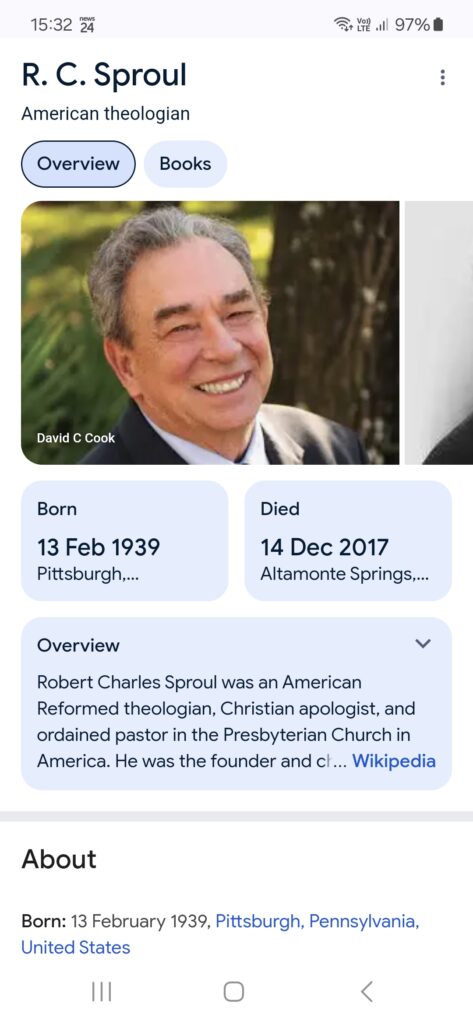
My assignment tonight is to speak about the problem of the relationship between the sovereignty of God and human freedom and after hearing Dr. MacArthur’s message earlier, I feel like the message that I’m to bring this evening is a concluding unscientific postscript to what we’ve already heard from his lips. He really captures the essence of the sovereignty of God, a concept that needs to be proclaimed again and again and again in the church because we tend though to think that God is impotent and that the arm of the Lord has waxed short, and the way in which Dr. MacArthur always grounds his views in sacred Scripture is a wonderful thing and I thought that today’s treatment of the subject was a tour de force and so really I’m just giving an epilogue to what you’ve already heard and before I read the Scripture, I’d like to ask you to join with me in prayer. Let us pray: “Our Father and our God, we rejoice that it’s You who is sovereign and not we ourselves that this is Your world and all that is in it and all that is in us has been moved by Thy Spirit to praise Your holy name, and rather than being intimidated by Your sovereignty, we rejoice in it and find our comfort therein. So speak to us tonight as we wrestle with this question of how Your sovereignty relates to our freedom. For we ask it in the name of Jesus. Amen”
I’d like to begin this evening by reading a brief passage from the book of Genesis. We’ve already considered with Dr. Duncan earlier today Genesis 1 which is the first chapter of the book of Genesis. Who knows what the last chapter of the book of Genesis is? Right, chapter 50. There was a resounding answer to that question. I’m glad there are a few Baptists here in this group that read their Bibles. Okay. I’d like to direct your attention really almost to the very end of the book of Genesis in chapter 50 beginning at verse 15 where we read these words, “When Joseph’s brothers saw that their father was dead, they said perhaps Joseph will hate us and may actually repay us for all the evil which we did to him.” And so they sent messengers to Joseph, saying, “Before your father died he commanded, saying, ‘Thus you shall say to Joseph: I beg you please forgive the trespass of your brother’s and their sin for they did evil to you.’ Now, please, forgive the trespass of the servants of the God of your father.’ And Joseph wept when they spoke to him.” Before I finish this text you’re aware of what has led up to this moment wherein one of the most cold-blooded acts of treachery and betrayal. Joseph who was the apple of his father’s eye had been sold into slavery by his jealous and envious brother’s and they took his coat of many colors and dipped it in the blood of an animal and came back to their home and their father, Jacob, with the story they made up that alas Joseph had fallen prey to a ravenous beast and had been torn limb from limb and was no more when in fact they had exploited the advantage they had to get rid of him by selling him to Midianite caravanners and traders who were on their way to Egypt. You know the story.
They came there and sold him in the slave market to Potiphar. He became Potiphar’s slave, and then the treacherous lies of Potiphar’s wife had Joseph thrown into prison where he languished year after year after year but never abandoned his faith in the Lord God. And then, through the mysterious manner of his ability to interpret dreams, Joseph was freed to interpret the troubling dreams of the Pharaoh, and because of that the Pharaoh appointed Joseph to be working with the erection of the store-cities for the grain to protect them against famine. And Joseph showed such a penchant for administration that the Pharaoh elevated him to the level of prime minister. You know the story, then how when the famine hit Canaan, Jacob sent his sons down into Egypt to get relief, to try to get goods from the storehouses to feed their family, and they came into the courts of Pharaoh and were met there by Joseph. Joseph recognized them; they didn’t recognize him. And all of the drama that unfolded in that encounter until finally, it became clear that the prime minister of Egypt was the brother that they had betrayed. And as all of this works out we finally come to the end of the story where Jacob, after having learned that his son was still alive, has died and the brothers now know that they don’t have the protection of their father, Jacob, to shield them from the vengeful wrath of their brother. They are now terrified, and they don’t know how to deal with it. And so, we’re told here that they said, “Maybe Joseph will hate us,” and they recognized instantly that Joseph had every right under the sun to hate them because what they had done to him was a despicable and hateful thing. And so they assumed that Joseph would behave toward them in seeking revenge with the same kind of fury that they had exercised out of their jealousy and envy against him those many years before. So now they are begging for forgiveness, but they acknowledge that what they had done was evil. “Thus you shall say to Joseph: ‘I beg you, please forgive the trespasses of the servants of the God of your father.’” And Joseph wept amid this acknowledgment of their sin, amid their repentance which we still don’t know was motivated by a genuine contrition or more out of a fear of punishment, but they acknowledged that what they had done was wicked, and it brought their brother to tears. Now, listen to what follows. “So his brothers went and fell down before his face, and they said, ‘Behold, we are your servants.’” Doesn’t that foreshadow the experience of the prodigal son and the New Testament or after he came to himself by living a life of licentiousness and determined to come home to his father’s house when he comes in repentance, he says to his father, “I am not worthy to be your son. Please forgive me and make me one of your slaves.” “I don’t have to be a son. I just want to be in your house. And I’m happy to be there as your slave.” And it’s the same idea here that the brothers are saying to Joseph, “Look, we’ve wronged you. We don’t expect you to receive us as your brothers. And they’re on their face, and they say, “Accept us as your slaves.” Now how does Joseph respond?” Joseph said to them, ‘Do not be afraid. Am I in the place of God? You’re on your faces before me as if I were the living God. I’m just your brother. I’m not ruling in the place of God. As for you, you meant evil against me. You acknowledged it. I’m not going to sugarcoat it. What you did to me those years ago when you betrayed me and sold me into slavery was unspeakably wicked. It wasn’t an accident. You knew exactly what you were doing. You meant it and intended it for evil.’” And it is as if Joseph was saying to his brothers, “You know, I thought about this a little bit over the last several decades. I had a lot of time in prison to think about this, and I’ve had to deal with the possible root of bitterness that would grow up in my soul because of what you guys did to me, but I’ve come to understand that you were not the only players in this episode. I’ve come to understand that the sovereign God of the universe, the Lord God of Israel, was intimately involved in your wickedness. You couldn’t have hurt me for a second. You couldn’t have damaged my heart or destroyed my relationship with my father. You couldn’t have had me delivered into the hands of my enemies and cast into prison for one second apart from the sovereign providence of God because God’s sovereignty was involved in your diabolical actions against me. And I believe in a God who works all things together for good to those who love him and who are called according to his purpose, and I believe that the Lord God of the universe has the sovereign power even to work your treachery against me for good.” “Now, before you relax and say, ‘Well, see, we were just carrying out the sovereign will of God. Certainly, you are not going to be upset with us for that. We can’t even say that the devil made us do it, but it’s this sovereign God up there that made us betray you.’” So just like Adam before them would say, “The woman that you gave me let me into this predicament,” Joseph is not going to give them that option. He said, “Let’s be clear. What you did was evil.” And Joseph was not about to call good evil or evil good. “What you did was evil and you meant it for evil, but what you meant for evil, what you designed out of the wicked machinations of your hearts for evil, God meant for good so that God’s intent in all of this was altogether righteous, that God in his sovereignty has the capacity and the ability to work through the sinful decisions and the wicked choices of his creatures to bring about His sovereign will which is altogether righteous.” Now, John has already shown how that works out in the New Testament, that the cross was not an accident. The cross was the most wicked evil ever perpetrated by human beings. Caiaphas meant it for evil. Pilate meant it for evil. The Pharisees meant it for evil. But over and above human intentionality, the human decisions that grew out of the evil inclinations and impulses of fallen human beings, God was at work to bring about good. I didn’t know, you know, I thought this place was a desert and I didn’t know that there were seals in the desert. Thank you. (He said that because they clapped their hands, and they laughed. Humor.) And you know, have you ever wondered why we call the most wicked event in the history of the world that took place in Golgotha that we remember that and called that day Good Friday? Why don’t we call it Bad Friday? We don’t call it Bad Friday because what God wrought in that action was the greatest good in the history of the world, in the atonement for his people. Now, what we see here in this passage, well, let me read it, the rest of it, “As for you, you meant evil against me. But God meant it for good, comma, in order…” Now those two words, “in order,” in the text express purpose. “God meant it for good,” God’s purpose in all of this, in order to bring it about as it is this day to save many people alive. So, don’t be afraid; I will provide for you and your little ones. And he comforted them and he spoke kindly to them,” not because of their good intentions, but because of God’s good intention. Do you know how God’s sovereignty works? You have the old adage, “For want of a nail, the shoe was lost. For want of the shoe, the horse was lost. For want of the horse, the rider was lost. For want of the rider, the battle was lost.” And so, the pivotal moment that decided the outcome of the battle was a single nail from the shoe of the horse. An insignificant detail became the pivotal reason for the loss of the battle. Have you ever thought of what led to Good Friday, whatever led to your salvation? Just go back a little bit in time. Jacob favors Joseph, so he makes this gorgeous coat of many colors for him, and he gives him that coat. And Joseph struts around like a peacock in the thing, and he tells his older brothers I had this dream where you guys were bowing down in front of me. And they said, “That’s it. It’s enough with the coat. You know, this kid has got to go.” And so they go and they sell him into slavery, And he goes. They just happened…it just so happened that when they were trying to get rid of him, just at that second, these caravanners were on their way to Egypt, and there was this unplanned intersection between the intentions of the Midianite caravan merchants meeting up with the plans of Joseph’s brothers. And so when they join together, everybody is happy. It’s a no-lose situation. The brothers get rid of Joseph, and the Midianite traders get a prize that they can sell him in the slave mart. So, they now go down to Egypt, and just by chance when they put this kid up for sale on the slave block, it just so happens that the one who gets the winning bid is this captain of the guard named Potiphar who just happened to be married to this unscrupulous woman who tried to seduce this young slave who was falsely accused, thrown into prison, where there happened to be his fellow prisoners, the butcher, the baker, and the candlestick maker. And while he’s in there, he is interpreting dreams for them. He just so happens that one of them gets out and goes to talk to Pharaoh, and Pharaoh has these nightmares, but good luck for Joseph, the candlestick maker remembers this guy back in prison who can interpret dreams. You know the story. So he finally brings him back. Joseph becomes the prime minister. The famine comes. The brothers come and they finally invite Jacob to come back down to Egypt. And if it hadn’t been for that, the Jews never would have sojourned in Egypt, but now they come and they live in the land of Goshen. They multiply, they produce, but, is just so happens that there comes this Pharaoh who didn’t know about Joseph, and instead of giving safe conduct to these Jewish immigrants, He decides to turn them into the slave labor force to take care of his public building projects. Well, as fate would have it, one of their women conceived and had this baby, and at the time the Pharaoh created this edict to destroy the children. And so, this mother not wanting her baby to be put to death, makes this little ark out of reeds and pitch, sets it adrift in the river, and consigns the fate of her child to the hidden providence of God. And so, the little thing starts to float down the river, starts to cry, and if that child hadn’t cried, nobody would ever notice the doggone thing, but it just so happened that Pharaoh’s daughter is down there doing her wash and she finds this baby, and she says, “Well, I got to take care of this baby.” She takes it home and raises it as the child of Pharaoh so that the little baby gets all the training of the best of the Egyptian court. But then, just one fateful day, without any intent, without any plans, nobody was lying in wait, it happens to see a guard mistreat one of the Jewish slaves, and in his anger, he rises and strikes this guard and kills him accidentally. It wasn’t malice aforethought. It wasn’t first-degree murder. He wants to hide the body, but somebody saw it. And because somebody saw it, Moses is banished into exile where he languishes as a shepherd in the Midianite desert until his old age. But when he least expected it, he’s taking care of the sheep one day and all of a sudden he looks over and he sees this bush that’s burning, it’s not being consumed. He says, “What is this?” And he turns aside and the bush starts talking to him and tells him…it just so happens that that was the place where God reveals Himself to Moses and God gives Moses the mandate to go to the court of Pharaoh and to say to Pharaoh, “I have heard the cry of my people. Let my people go.” And what follows is the greatest redemptive event in the whole history of the Old Testament, the exodus. God saves his people, enters into a covenant with them, makes them a nation, gives them his law, conquers the land, gives them a king, sends them his prophets, and a couple of thousand years later, out of all of this, a baby is born in Bethlehem. And we could go on with this story, but you realize, all of this because of one lousy coat of many colors. No coat, no jealousy. No jealousy, no betrayal. No betrayal, no sale into slavery. No trip to Egypt, no Potiphar. No Potiphar, no Potiphar’s wife. No Potiphar’s wife, no prison sentence. No prison sentence never meets the butcher, baker, and candlestick maker. He doesn’t meet them, he never gets acquainted with Pharaoh. He’s never elevated to the prime minister. The children of Israel never settled in the land of Goshen. There’s never a slavery. There’s never an Exodus. There’s never a nation. There’s never the Ten Commandments. There’s never the kingdom of God. “You meant it for evil, but God intended this for good, to save many people.” Is that incredible? You know, but when we deal with these difficult questions that we have to struggle with as Christians, it always comes up on the list. How do we reconcile the sovereignty of God with human freedom? Now, I have to say a couple of things about this that seem to be almost contradictory. In the first instance, I have to say, as a brand-new Christian, as a Christian of only a couple of months, I thought about this question and I was troubled by it. I thought it seemed to me that I was facing a contradiction here between human freedom and divine sovereignty. I’m thinking, if God is really sovereign, then we can’t really be free, or if we’re really free, God can’t really be sovereign. And so, I was in a college that was church-related and it was a very, very weak relationship, but as one in which there was still a requirement to take Introduction to the Old Testament, which I was doing as a freshman, I raised the question to the professor, “But what about God sovereignty and human freedom?” And he kind of screwed up his forehead to look for profundity, you know, and he talked in hushed terms. He says, “Ah,” he says, “it’s a mystery.” He said, “it’s like God’s sovereignty and human freedom are like parallel lines that meet in eternity.” And I heard him say that and I thought, “Wow! That’s heavy stuff. This professor is really smart.” Parallel lines that meet in eternity. I left the classroom and I went back to the dorm. And I liked to play ping-pong then. I was playing ping-pong, and I was at one of those ping-pong games and I’m thinking, “Parallel lines that meet in eternity.” I’m thinking, “If those parallel lines meet in eternity; if they meet in Albuquerque, in Dallas, in Atlanta, or New York City, never mind eternity, they’re not really parallel lines now, are they? Because if they are really parallel lines, they are not going to meet in Albuquerque or anywhere, let alone eternity.” I said, “On the other side, if they do meet in eternity, then they are not really parallel lines,” so that this seemingly profound answer to my question sort of fell by its weight, and I thought, “You know, that’s really silly, to talk like that.” Then I got another one. He tells me, “It’s like, when you go get water out of a well, you have this bucket up at the top and it’s attached to a rope and you let that bucket down to the bottom of the well, you can’t see, it’s too dark down there, and you drop it down in there and you let the bucket collect some water and then you pull it back up and you have your water.” And he says, “Do you realize that there are two ropes that go down there, but outside of your site they wrap around the pulley at the bottom and so their connection and their unity is beyond the scope of your vision? And that’s kind of how it is with the sovereignty of God and human freedom.” But what we’re talking about here, folks is not getting water out of a well. And I realized that by the time I was just a Christian for about 3 months, well what’s the big deal with this question? This question is really not a tough question at all. It’s a very simple question, and what amazes me is how so many people seem to stumble over it. There’s really no problem. There’s no contradiction. There’s no mystery at all. You have God who is a being and you have people who are beings, and when we talk about the difference between the two, we call the beings that we are “human beings,” and when we call or refer to God, we say “the Supreme Being.” Now what’s the relationship between human beings and supreme beings? Well, the main thing we have to understand there is which one is supreme. We don’t call people “supreme beings;” we call them human beings. It’s God who is the supreme being. Now, God is a volitional being. That is to say that God has a will. He has a divine faculty by which He makes decisions, and by which He undergoes choices. We, as His creatures, are also volitional beings, and part of our humanity is that our Creator has endowed us with the faculty of choosing which we call “the will.” And what having a will and the faculty of choosing means is that we can make choices. And that’s what we’re concerned about when we’re talking about freedom and about free will, the ability to make choices. Now, back in the nineteenth century, in Europe, there was a very important philosopher whose name was Edmund Husserl. Now most people on the street have never heard of Edmund Husserl, who was one of the leading founders of a school of philosophy called personalism, and one of the things that the philosophy of personalism was trying to answer was the question, “What makes human beings unique? What is it that defines our existence as human beings, as persons? What does it mean to be a person rather than a thing?” and the answer that Edmund Husserl gave to that question was simply this, that human beings can act with intentionality. That is, we can conceive of a purpose that we want to accomplish and we can make choices and decisions in order or for, for the intent, of bringing that idea to pass. And so Husserl insisted that absolutely central to our humans is the fact that we have the ability to make choices. Now I said most of you probably have never heard of Edmund Husserl, but I suggest that most of you have heard at least of one of his two famous disciples. His two most famous students were Jean-Paul Sartre and Martin Heidegger. So you have Satre and Heidegger, who are two of the most significant atheistic philosophers of the twentieth century. Both studied under Husserl; both were preoccupied with the whole concept of human volition. Sartre came to the conclusion that it’s human freedom that is the strongest argument there is against the existence of God. Sartre reasoned in this manner: He said, “If man is truly free, God cannot exist, and conversely, if God exists, man cannot be free.” Now, those were the options, And he said, “We know for sure that we are free. We know for sure that we are moral creatures, that we are volitional creatures. So that proves that there can’t be a God.” Well, there was one element in his reasoning process that I haven’t explained to you yet. In defining freedom Sartre argued that freedom means autonomy. Let me say it again, freedom means autonomy. And unless you’re freedom is elevated to the level of autonomy, you’re supposed freedom is but a mirage. Okay. What is autonomy? What is an automobile? You all know what an automobile is. It’s the thing that guzzles your gasoline every day. The word “automobile” has a prefix and a root. “Auto” means “self.” “Mobile” has to do with movement. An automobile is a machine that moves itself, except when it runs out of gas. Then, we have to push it, and it’s no longer an automobile. But the word “auto” means self. The Greek word for law is the word “nomos.” You’ve heard it already today, the word “antinomian” means “against the law.” And so the word “autonomy,” auto-nomos, means literally “self-law” or “self-rule.” And so the idea Sartre had was this, that to be truly free we have to have absolute freedom, we have to have autonomy meaning that we have no accountability ultimately to anyone outside of ourselves. So obviously if I am autonomous, if I rule myself, there is no room in that scenario for a sovereign omnipotent deity who reigns in heaven over all things. Now if you want to find an insoluble contradiction, an antinomy that no amount of insight can resolve, it would be the conflict between divine sovereignty and human autonomy. Those two cannot mutually exist in the same universe, just like we understand that there cannot coexist in the same universe an immovable object and an irresistible force. Now we can conceive of an irresistible force, and we can conceive of an immovable object. What reason cannot conceive is the coexistence of two objects, one of which is immovable and the other of which is irresistible. Why not? If an irresistible force meets an immovable object and the object moves, what does that tell you about the force? What does that tell you about the object? It’s not immovable. If an irresistible force meets an immovable object and it doesn’t move, what does that tell you about the irresistible force? It wasn’t irresistible. You thought it was irresistible. And the old songwriter understood this. Some of you with snow on the roof, remember the song? It goes something like this, “If an irresistible force such as you meets an immovable object like me,” then what? “Somewhere, somehow, da, da, da, da. Something’s gotta give, something’s gotta give something’s gotta give in.” Remember that? That’s the way they used to write songs in this country. What you can’t have is a universe where you have a sovereign God and an autonomous creature. And only if you think of human freedom as rising to the level of autonomy do you have this problem. But nowhere does the Bible ever teach that human beings have been given autonomy by God. On the contrary, autonomy is the illegitimate, illicit reach of creatures made in submission to a sovereign God. You know, what we read in creation is that when God put Adam and Eve in the garden. What did He say? “You live in this garden, and you’re not allowed to do anything. I have all these trees with all these beautiful foods there in the garden I’ve made, but you can’t avail yourself of any of them. Don’t you touch any of those trees because if you touch a single tree in that garden you will die?” Is that what God said? That’s what the devil said that God said, but that’s not what God said. Here’s the first introduction to the concept of freedom. “Of all the trees in the garden, you may freely eat, except this one over here. You may not eat of that. If you do, you die.” What God gave human beings in creation was the ability to make choices, but that ability was not unlimited. It was limited. “Of all the trees,” God said, “over here you may freely eat, but you can’t just do anything you want to do. There are limits to your freedom. There are restrictions to your freedom.” And the thing is this, God is free and his creatures are free, but God is freer than His creatures. Now that’s simple. You would think it would be simple, but here’s the kind of stuff I hear all the time in the church. See if you’ve heard this one. “God’s sovereignty is limited by human freedom.” Have you ever heard that? Beloved, that’s not good theology; that’s blasphemy. Because if you say that God’s sovereignty is limited by your freedom, who’s sovereign? You are! You are given now autonomy. You are given freedom that exceeds the freedom of God Himself. Here’s one even worse, “God saves as many people as He possibly can.” You know, He’d like to save everybody. He does the best He can, but if He would work in your heart to change your heart without your permission, He’d be violating your freedom, and so God can’t save you unless you want to be saved. And the sinner in hell would give everything he had and do anything he could to get rid of that freedom that kept God from saving him. On the road to Damascus, Saul of Tarsus did not ask Christ to save him. When God intruded into my life through His sovereign good pleasure and changed the disposition of my heart, I wasn’t seeking Him. I didn’t ask him to come in. He came. That’s how he came to you. He didn’t destroy my freedom. He elevated it because until he did that I was a slave to my own wicked inclinations. Now, in the doctrine of providence, we talk about the doctrine of concurrence, how there can be the choices of God at the same time there are choices of men, and how God works through the choices of human beings without annihilating our choices. God did not rob Joseph’s brothers of their freedom. Joseph’s brothers did exactly what Joseph’s brothers wanted to do. God didn’t coerce them, God didn’t force them, but God exercised His sovereignty through their free decisions. That’s an amazing thing. It is a good thing, and I rejoice that my freedom never places a limit on God. If I choose to do anything that I do, if I choose to raise my hand right now as an exercise of volition, my mind has decided it would be a good thing for me to raise my hand and that notion somehow has communicated to the body, and the interaction between non-extension and extension takes place in this activity where I raise my hand. What if God didn’t want me to raise my hand? What if God sovereignly decreed that I would not be able to raise my hand? God knew I was going to raise my hand and he said, “No. You are not gonna raise your hand.” Could He annihilate me before I raised my hand? Could he remove my ability? Absolutely. There was already a reference earlier to the Westminster Confession that says, “God ordains from all eternity freely and changeably whatsoever comes to pass, but not in such a way as to do violence to the will of the creature or to do away with secondary causes.” My ability to raise my hand is a real power. I can exercise real causal power by deciding I want this effect of raising my hand, but always and everywhere I live and move and have my being in God, and I can’t even raise my hand without the primary power of God. So, if you’re going to deal with this problem of human freedom quickly, you got to get rid of the pagan idea that has infiltrated the church that free will means autonomy or that free will means that as a creature you have the ability to inclined yourself either to the good or to the bad with equal power. No. God says that by nature in your sin you’re a slave. You still have a will, you still have the ability to make choices, but your choices are wicked, you are morally incapable in and of yourself until you are enabled by God the Holy Spirit ever to choose the holy things of God. If God said, “Here I am. Here’s Jesus. Here’s no Jesus. Take your pick,” the humanist, the secularist, that person says you have the equal power to choose Jesus or not to choose Jesus. The Bible says, Jesus says, if that option is set before you in your sin, in your corruption, in your state of spiritual death, you will not choose Jesus because you cannot choose Jesus, and the reason you cannot choose Jesus is because you will not choose Jesus. See, the simple thing is you cannot choose what you don’t want. What choice is choosing what you want the most in a given situation, the most powerful inclination that you have at the moment? So choices don’t happen in a vacuum. They are not magic. Every choice that you’ve ever made has a motivation behind it. It’s your motivation, not somebody else’s. You’ve never once in your whole life done something that you didn’t want to do. I have a hundred dollars in my wallet that I will give not to the first person, but however many of you can do it, who can tell me tomorrow after thinking about it all night of a single action you’ve ever done in your life that you didn’t want to do. You can say, “Wait, I don’t have to go to bed and think about that. I’m at this conference, and it’s the last place I ever wanted to go.” I’d say, “Well, why are you here if you didn’t want to come?” “You don’t know. My wife, if I didn’t come to this conference she was going to make my life hell on earth, and I had no desire to come to this conference.” And I said, “Yes, but at the time of the decision your strongest inclination was to acquiesce to the wishes of your wife rather than to live in the misery that you would have if you didn’t.” It’s like Jack Benny. You remember the old skit when he would be in front, giving his dialogue, and a guy coming from the side of the stage with a mask and a gun, and he would point the gun at Jack Benny and say, “Your money or your life.” And Benny would go…and the burglar would say, “Come on. What’re you doing?” He says, “I’m thinking about it.” You see, even in that, what the burglar does is he doesn’t force you to give him his money; he just reduces your options to two, and he leaves you to decide whether you want to give him his money or whether you want to die. You will choose according to the strongest inclination that you have at the moment. That’s the way human choice operates, and God knows that. And God has the wisdom and the power to work through our desires to bring about His plan. Even if and when our desires are altogether evil, God can and does work through our evil desires to bring about his good purposes. You meant it for evil, but God meant it for good. Just remember who is sovereign and who isn’t, and this will never be a problem for you. Let’s pray. “Father, we are so glad that it is You who is sovereign. We thank You for the degree of freedom You have given to us, and we thank You for the liberty that is ours in Christ, that by the power of the Holy Spirit, You’ve empowered us now to choose Jesus, to want Jesus, to desire that which was once completely undesirable to us. When once we didn’t want You in our thinking, You have given now to our soul a desire to know You and to love You. Thank You for the exodus of our souls from the bondage of sin, amen.”